
Email LinkedIn Twitter

Perspectives on decentralized organizations at South by Southwest Interactive Festival

As technology has increasingly created a number of self-organizing online or real communities, companies are also experimenting with cultural changes such as  decentralization.

This trend was discussed in depth at the South by Southwest Interactive Festival, led by Amgen, Inc. Executive Director James Taylor, Burning Man Human Resources Manager Kat Steinmetz, and Second Life Founder Phillip Rosedale.  These professionals discussed the burning question of “Decentralized Organizations: Do They Really Work?” Highlights …

Thought leader and author of The Future of Work Thomas Malone shared insights into why things are changing

  • “For the first time we can have big business economy of scale and small business human culture.”
  • “We’re in the early stage of change in business, similar to change we saw in democracy/government”
  • “Old structure for corporations are based on efficiency. Today’s is about innovation; new focus is intelligence”
  • “Benefits of decentralized decision-making are exactly the same as drivers for business success-innovation and flexibility”

Exploring and using non-traditional techniques to structure their organization

  • It’s not just about cool tech startups (example Zappos model), huge productivity boost
  • Burning Man has no CEO. Instead 6 execs who decide by consensus. Slows decision-making, but speeds up implementation
  • We need to rethink the efficiency metric, place more emphasis on collective intelligence
  •  The point is to build community, not to be efficient

The future forecast for organizations is uncertain

  • In a few years maybe no one will work for technology companies. Employment is going to change so substantially.
  • Anonymous surveys, voting systems for both customers and internal employees, organic management, and peer-based recognition systems are becoming more commonly used

Thanks for your insight, @bombaycowgirl, @ACoulton, and @CofoMan!
Content marketing to woo the executive | webinar highlights


In marketing, content is key and white papers can be a crucial part of lead generation.  Creating content can be easy, but creating good content to motivate your reader to take action is hard. An executive will be more likely to read because he/she knows will answer questions & educate about possible solutions.

The webinar “Content Marketing to Woo the Executive: Designing white papers that grab prospects, nurture leads, get shared, and produce sales” offered best practices on producing good content to attract an audience and generating a call-to-action.

Content marketing expert, Jonathan Kantor, principal and founder of the Appum Group, discusses how to adapt your white paper to new media, creating adaptive content for different channels, and techniques to engage your reader.

Moderator:  Thorin McGee of Target Marketing executive editor

 Social media’s impact on communication

  • Content: Abbreviated information, video links, hyperlinks
    • Pros: Allows us to access info quickly
    • Cons: Short attention spans, impatient readers

New media (social media) has replaced longer text-based information (white papers)

  • Result: “Short Attention Culture” & executives are not reading as much text
  • Solution: White papers must change with the times & faster bottom line delivery

Traditional white paper

  • Text heavy
  • Lack of summaries
  • Little to no graphics
  • No call to action

New white paper practices

  • 6-8 pages max
  • Educational: Content & value is key, don’t focus on sales
  • Convincing: Use visuals to create call to action
  • Accurate:  Facts, statistics, research vs. opinions
  • Solution: Understand problem & provide answer

Bottom line:  The “new” white paper must be crafted to entice the social media savvy, short-attention spanned executive while remaining educational, convincing, and accurate.

White papers are read in a layered style

  1.  Skimming: Is it good use of time? Hook reader with business charts, side bar quotes, and shaded text
  2. Preliminary: 15-30 minutes of reading; use concept graphics
  3. Comprehensive:  Reader is hooked and white paper is part of their business decisions

Tips to get your white paper read

  • Engage the decision maker
  • Establish a connection with the reader
  • Have hooks at each layer
  • Employ similar visuals as you would in social media

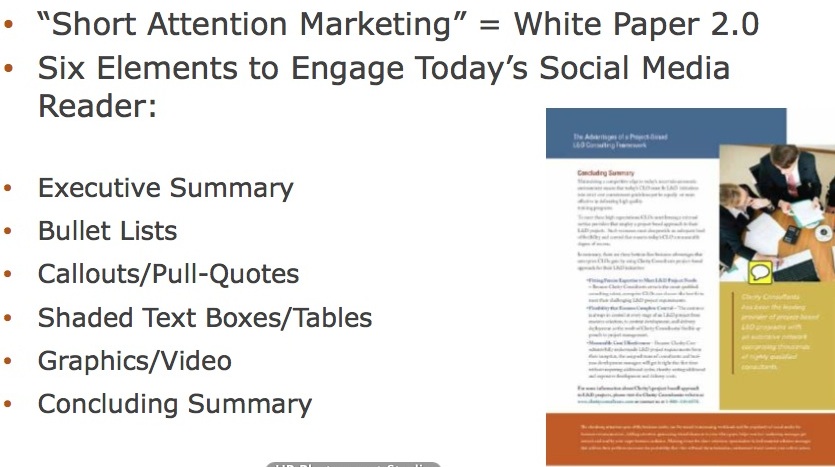
Short Attention Marketing = White Paper 2.0


  • Executive Summary: 1-page synopsis, provide incentive & reduced content:  Situation, problem, solution, result
  • Bullets: List of components that comprise an idea; great for quick scan
  • Callouts/pull quotes: Important statements, don’t have to be text, but make them STAND OUT
  • Shaded textbox/tables: Bottom line, don’t use too many (1-2 ideal)
  • Graphics/video: Replaces text, simplifies complex solution
  • Concluding summary: Final point, translate points to how biz benefits

 3 SEO tips

  • Keywords: Use long-tail keywords, embed often in the white paper
  • Use metatags
  • Optimize volume: Blogs, landing page optimization

Repurpose content

  • Generates faster ROI
  • Improves brand image
  • Strong customer connection

How to repurpose content

  • Case studies
  • Videos
  • Podcasts
  • Statements of direction
  • Tip sheets
  • Presentations

First started in 1922, the white paper has established itself as a document of knowledge, influence, and credibility.  Although the times have changed and despite the “short-attention culture” of our social media world, white papers are often still highly important in lead generation.

When it comes to crafting white papers, keep your reader in mind:  Keep content concise, true to form, and provide a solution and a call-to-action.

Designated Editor Offering Small Group Workshops and Seminars in Newport

New Media Workshops and Seminar Series Offered

The 1,000+ who have turned out for Newport Interactive Marketers event have proven one thing: There’s a great thirst for new media insights. So often the hourlong NIM presentation has merely sparked greater interest, without a means to develop the fundamentals.

Designated Editor has developed 2 distinct learning offerings to place small business owners, entrepreneurs, and others in the new media driver’s seat.

What makes these new media learning opportunities different?

  1. You’ll be doing the work with significant guidance and the opportunity to ask plenty of questions.
  2. Small groups provide an affordable way to learn, and learn by doing.
  3. You’ll be learning from Social & Content Strategist Suzanne McDonald, who teaches university-level courses in Social Media and Event Planning.

Leverage LinkedIn & Twitter: Hands-on Workshop

  • Craft an attractive profile for you and/or for your company
  • Find and connect with key influencers: for employment, sponsorship, or partnerships
  • Utilize LinkedIn’s key features: Groups, Events, Skills, Answers, Recommendations, Reading List, and more
  • We’ll also explore Twitter

Limited opportunity, sign up now & for more info

Facebook for Small Brands: Hands-on Workshop

  • Your Facebook brand page up and running
  • An attractive Facebook Timeline
  • Hands-on experience and Facebook know-how
  • Your questions answered so you’ll know what to do next

Limited opportunity, sign up now & for more info


New Media Small Group Seminar Series

This group will meet weekly for approximately 10 hours total. Bring your laptop to become comfortable & successful using new media:

  • How to update a WordPress website & blog
  • Structuring your blog
  • Developing your editorial calendar
  • Relevant social media platforms (LinkedIn, Twitter, Facebook, Pinterest, etc) and
  • Reaching out to bloggers and media

Limited spots available, for more info. Or email Suzanne for a calendar request: Sue(at)DesignatedEditor.com

Small Organizations Can Create a Big Social Media Presence

Aimee Roundtree

When time, money, and help are hard to come across, it’s time for organizations to incorporate strong social media strategies. Many small brands are seeing big success with social media, whether for outreach, education, PR, or promotion. South by Southwest Interactive provided tips on how to create a strong social media presence.

If you want to do big things with social media at your small organization, you have to be creative and flexible, use what works, and know thyself to create a campaign that’s effective and works for you (and most importantly, your audience), according to Aimee Kendall Roundtree, University of Houston-Downtown Associate Professor in the Professional Writing Program. Highlights from Big Social Media Results for Small Organizations:

Social media for small organizations: Best Practices

  • Invite participation
  • Set and know your metrics and perform sentiment analysis
  • Know you purpose and set policies and training programs invite participation
  • Set smaller goals and achieve them
  • It’s good for small organizations to be talking about news, events, and partnerships with other organizations
  • Track interactive patterns, build metrics and tools as you need them.
  • Do what works for your organization, which may be unique to your audience and brand
  • Being adaptive is a best practice because money and time are the biggest barriers
  • Hashtags build community structure, be sure to put your mission first
  • When establishing strategies, small organizations should use messages for content, not memories
  • Small organizations can often do well by amplifying user-generated content

Make the voice of your organization heard through social media

  • 73% of small orgs using social media. Of those not using, 81% plan to start
  • For small organizations, often the best social media posts don’t support the strategic plan or goal
  • Use social media to embody the organization. Share daily goings-on and be intimate in a brand-appropriate way
  • Film events, share anecdotes and other clips to help feed social content. This helps a small organization to show activity
  • Be aware: Despite organizations’ goals/purpose, users can change direction through contributed content

 Be brave when branding your organization through social media

  • It’s OK for small organizations to wing it! Just use your intuition
  • When it comes to social media, intuition can be more effective than best practices
  • Don’t be afraid to say what you need to say, provide real content about what’s happening. Be concise and consistent
  • Consider the ant: How is it that ants accomplish so much without someone telling them what to do?

Thanks to @akroundtree, @ACDunbeck, @inthekisser, @mirandaLwilson for your insights!